

EXPO 2025
Special Page

Information
As humanity sets its sights on lunar exploration and the establishment of long-term settlements beyond Earth, achieving self-sufficiency in food and oxygen remains an unresolved challenge. To tackle this issue, CHITOSE Group, in collaboration with the Japan Aerospace Exploration Agency (JAXA), has launched an experiment at the International Space Station (ISS) to validate its novel Spirulina cultivation system for efficient protein production and air revitalization in space as part of the “Space Surface Spirulina” project*.
On April 11, 2026, the proprietary immobilized biofilm photo-bioreactor was transported to the ISS aboard the Cygnus NG-24 spacecraft and installed in the Japanese Experiment Module “Kibo” for a 16-day cultivation cycle.
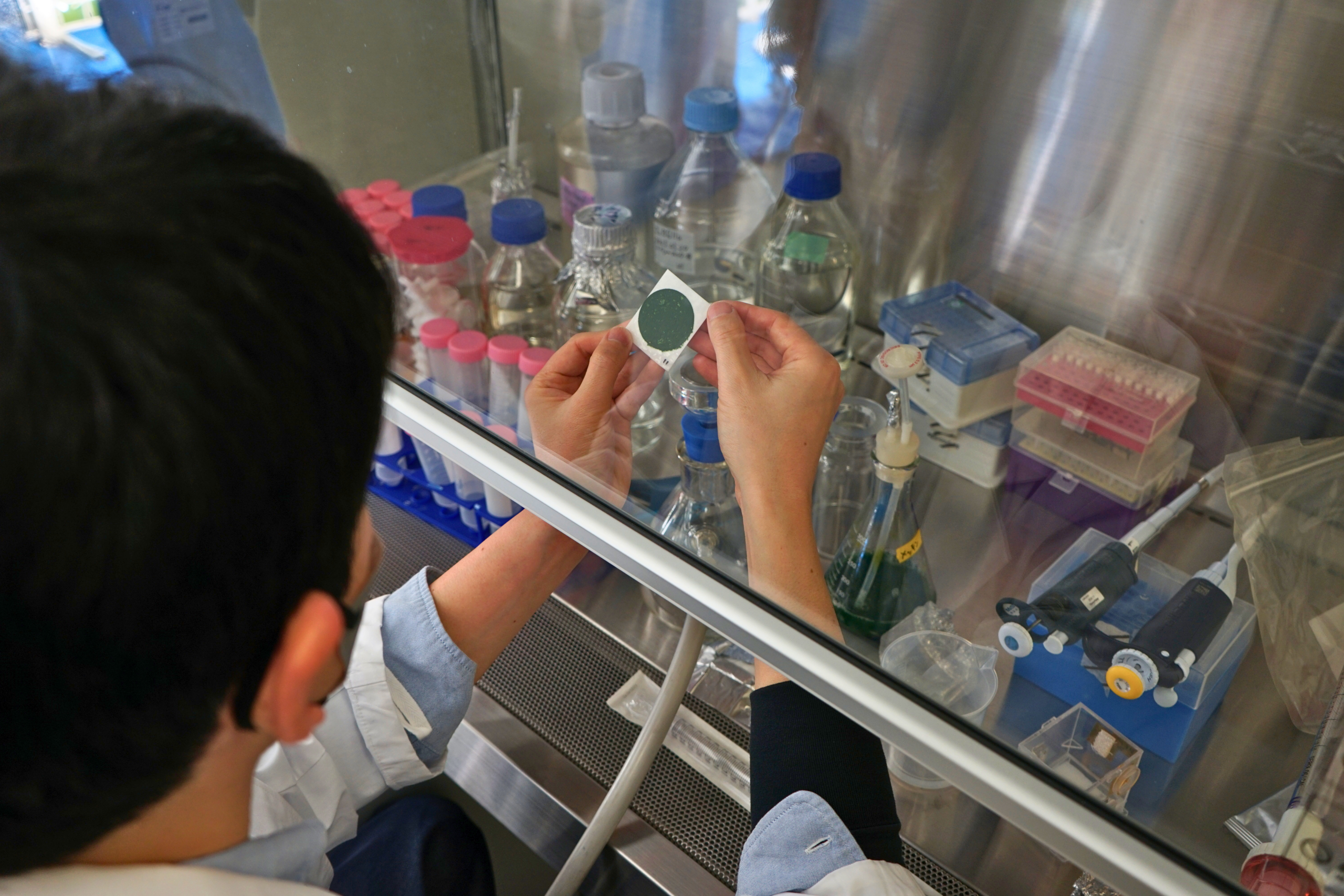
CHITOSE BioEngineer Takashi Inada conducting the seeding procedure rehearsal before the launch
The ISS environment, compared to the on-Earth conditions, is defined by multiple constraints, such as microgravity, limited experimental space, and limited water resources. To adapt, CHITOSE developed a proprietary immobilized biofilm photo-bioreactor. While traditional liquid suspension methods grow microalgae in large volumes of liquid, the novel approach attaches the microalgae to the surface of a carrier, allowing for high-density cultivation using only a small amount of medium. This method is projected to utilize just 1/25 to 1/100 of the water required by standard terrestrial commercial methods while drastically reducing the required installation area.
Throughout the cultivation cycle on the ISS, humidity is continuously logged while temperature and visual status are monitored via real-time telemetry to evaluate how space conditions influence biological stability. Following the experiment, samples will be frozen on-station and returned to Earth for further analysis.
Comment from Naoko Yamazaki, Former JAXA Astronaut
“As the sphere of human activity in space expands, the importance of circular life support and environmental control is becoming increasingly vital. This space-based demonstration, which harnesses the photosynthesis of Spirulina to support both food and air, is a globally groundbreaking initiative. I look forward to this project opening up new possibilities for our future,”
– Naoko Yamazaki, a Japanese engineer and former JAXA astronaut, reflecting on the CHITOSE x JAXA joint “Space Surface Spirulina” project.
Naoko Yamazaki first encountered CHITOSE’s work at Expo 2025 Osaka, Kansai. There, the company served as technical supervisor for the microalgae exhibition, demonstrating the industrial potential of these microorganisms to support daily life. Recognizing its potential for space applications, she later visited CHITOSE to further explore how this technology can contribute to the development of new bio-based industries.
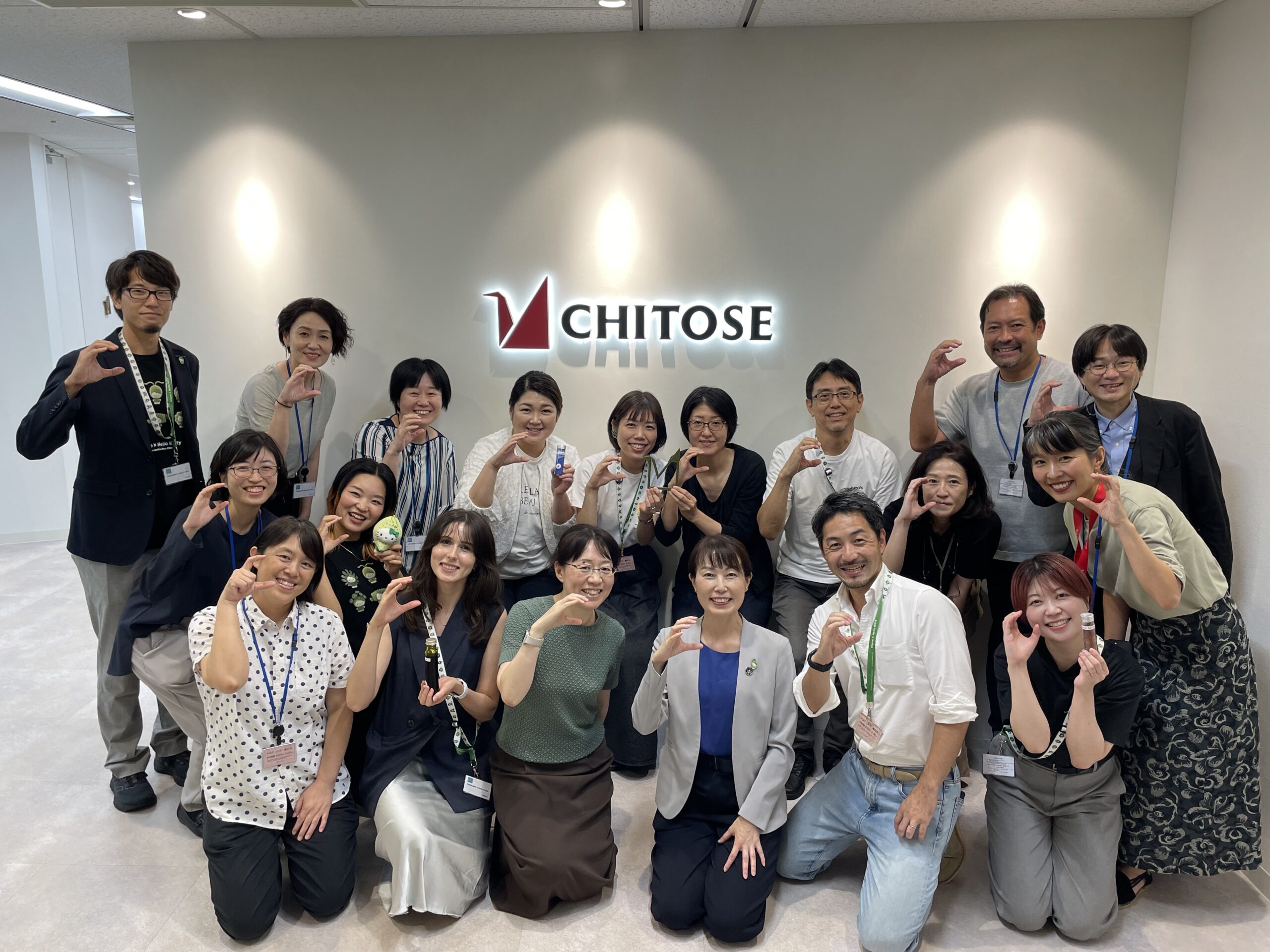
Naoko Yamazaki, the second Japanese woman to travel to space, during her 2025 visit to CHITOSE.
She is joined by team members showcasing microalgae-derived raw materials.
By utilizing the power of microorganisms, CHITOSE is laying the foundation for stable production of food in space, taking a major step toward supporting long-term extraterrestrial settlements.
*The “Space Surface Spirulina” project is the continuation of years of collaboration with JAXA. Following initial research on the development of a small scale and efficient protein production platform from 2018 to 2019, JAXA selected CHITOSE proposal in 2021 to develop an efficient protein production and air revitalization system as a research theme at the Kibo module, culminating in the current project.
Related Information
[NASA] Nutrition Research Arrives Aboard Space Station
[NASA] Space Station Research Explorer | Space Surface Spirulina
[Press Release] Algae to Power Space Nutrition: Research Project to Develop a Compact Spirulina Protein Production System Selected for JAXA’s Space Exploration Innovation Hub (JPN)
[Press Release] Tabérumo Starts Joint Research on Lunar Spirulina Cultivation Systems and Fresh Space Food Development (JPN)

